
News

As our Executive Director stated in her letter, one of SDBIF’s goals is to find new and effective ways to address reintegration challenges and provide meaningful solutions by offering individualized navigation action plans for survivors.
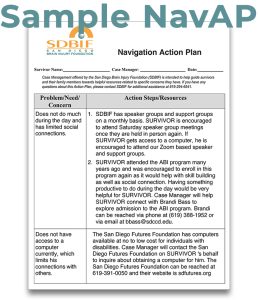
Sample NavAP with captionWHAT IS A NAVIGATION ACTION PLAN?
A Navigation Action Plan (NavAP) identifies a survivor’s needs and current barriers and provides steps on how to address, work through and overcome them.

This plan serves as a roadmap, outlining the steps the brain injury survivor must take to progress towards their short-term goals. The NavAP addresses the survivor’s physical, emotional, and cognitive needs, as well as personal goals and preferences; and includes tailored recommendations and actionable steps, ensuring that the survivor has a clear and achievable pathway to follow.

HOW DOES A SURVIVOR OBTAIN A NavAP?
A survivor needs to do a simple 30-45-minute assessment completed with a SDBIF Program Coordinator. These are completed over the phone (or it can be in-person), where the Program Coordinator will ask a series of questions to get to know and understand the survivor’s situation, challenges, and aspirations better.

Better yet, It is VERY easy to ask for one of these assessments to be done. All a survivor has to do is call SDBIF’s Telephone Helpline at (619) 294-6541 or email info@SDBIF.org and ask to schedule one!

HOW MUCH DOES A NavAP COST?
NOTHING!!! These are Free-of-Charge thanks to funding from the California Department of Rehabilitation and the generous donations of SDBIF’s supporters.

WHAT ARE NEW BENEFITS SURVIVORS HAVE ACCESS TO AFTER COMPLETING A NavAP?
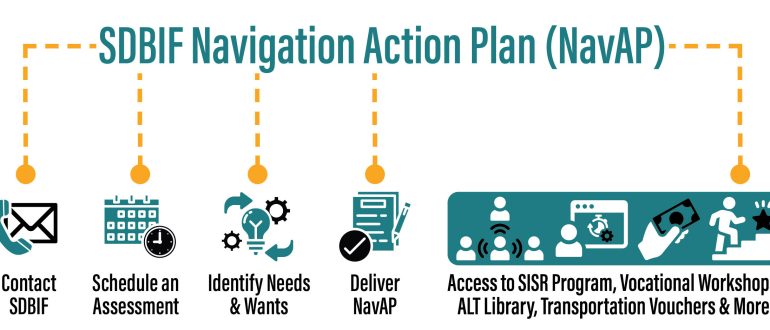
SDBIF has begun a series of new initiatives in 2025 that active, participating survivors will have access to, once a NavAP is completed.

SISR Program
SDBIF is partnering with SDSU’s School of Health and Human Services–Center for Clinical & Cognitive Neuroscience to launch the Students Invested in Survivor Reintegration (SISR) Program. This advocate-based initiative pairs junior and senior undergraduate students with TBI survivors to assist with facilitating their reintegration from rehab to community life. Guided by Dr. Stephaine Ries, Professor, Dr. Roslyn Knox, SDBIF Executive Director, and Dr. Dan Gardner, M.D., a renowned brain injury expert, participants will receive training and support to ensure effective enrollment and engagement.

The objectives of SISR include weekly 1-on-1 meetings between students and survivors to enhance daily living and communication skills, advocacy support for navigating community resources, organization, and goal setting. Additionally, students will assist survivors with technology through workshops. The program will operate repeatedly on a semester basis, with ongoing assessment and reassessment using standardized instruments to track outcomes.

Community & Vocational Readiness Workshops
Partnering with Rehab Without Walls, SDBIF will host a monthly workshop series, each session led by licensed practitioners in various therapy disciplines. These interactive workshops will cover essential strategies and skills to prepare participants for re-entering the community and the workforce.

Assisted learning Technology Library
SDBIF is committed to bridging the digital divide after brain injury to address technological literacy needs. Recognizing the importance of access to technology and assistive devices, SDBIF will establish the Assisted Learning Technology (ALT) Library where workshops will be held to assist survivors in re-learning essential technology skills. This ALT Library will provide survivors and their families with access to computers, the internet, assistive technology, and printed materials, serving as a hub for workshops and technological assistance services.

Transportation Vouchers
Recognizing transportation barriers faced by survivors, SDBIF will offer financial assistance to enrolled survivors in need. Collaborating with rideshare services and public transportation systems, SDBIF will provide passes and vouchers for healthcare appointments, social services, and SDBIF programs. Additional assistance may be available upon request.

What's next graphic
UNITED FOR REINTEGRATION
SDBIF’s Navigation Action Plan (NavAP) provides survivors with a personalized roadmap to overcome challenges and achieve their goals—all completely free. With new 2025 initiatives like the SISR Program, vocational workshops, assistive technology resources, and transportation vouchers, survivors have more support than ever.

If you or a loved one could benefit from a NavAP, reach out today! Just call (619) 294-6541 or email to info@SDBIF.org to start your reintegration journey. Your future is ready—let’s navigate it together!


TIAA-CREF Tuition Financing, Inc. also Oversees Treasurer’s ScholarShare Program

August 8, 2018 | Contact:Press Office, news@sto.ca.gov, 916-653-2995

SACRAMENTO – California State Treasurer John Chiang today announced the selection of TIAA-CREF Tuition Financing, Inc. (TFI) to administer the California Achieving a Better Life Experience (CalABLE) Program.

“TFI’s selection means we’re one step closer to turning on CalABLE’s ‘Open for Business’ sign,” said State Treasurer John Chiang. “TFI’s expertise and oversight are a welcome help in reaching Californian’s with disabilities and their families, who will soon be able to save up to $15,000 a year, tax free, without jeopardizing their federal and state assistance.”

Currently, savings for individuals receiving Supplemental Security Income (SSI) or other public benefits have a $2,000 resource limit. Once a beneficiary is determined to have more than this $2,000, their benefits may be suspended until savings fall below that level. CalABLE — the state’s version of the federal ABLE Act — allows people with disabilities to establish a tax-advantaged savings account in which they can save up to $15,000 per year, up to a total of $100,000, without jeopardizing their ability to continue to receive existing public benefits. Earnings into CalABLE accounts are not subject to federal income tax or California state income tax, so long as the earnings are spent on a broad range of disability related expenses.

“We are excited to see the CalABLE program move forward in providing people with disabilities the opportunity to build their futures,” added Christina Mills, executive director of the California Foundation for Independent Living Centers. “There are very few ways for people in our community to save money without penalties. Opening a CalABLE account will be a game-changer for individuals with disabilities, and parents of children with disabilities, who have been limited by programs and services that prevent us from saving and becoming more independent.”

TFI was selected to manage the new CalABLE program by a vote on Tuesday by the CalABLE Act Board, based on the firm’s low costs, proposed investment portfolio that offered simple choices for enrollees with clear preferences, and the simplicity of its program for those new to such a savings program.
TFI is a national leader in providing program management services for college savings plans and currently serves as the manager for California’s successful ScholarShare 529 college savings program.

Any individual whose disability occurred before age 26 is eligible to open a CalABLE account so long as they receive benefits based on disability, such as SSI or Social Security Disability Insurance, or if they have disability certification (including a copy of a diagnosis signed by a physician).

CalABLE participants can:
• Make automatic contributions from a bank account
• Invite family and friends to contribute directly to an account
• Deposit online or by check
• Select from easy to understand investment options

Chiang added, “No one should have to fear losing their disability benefits because they decided to save wisely and invest in their future. This program will help ensure no Californian with a disability will be penalized for thinking ahead.”
CalABLE will launch by the end of 2018.

For more information about CalABLE visit https://www.treasurer.ca.gov/able or call 916-653-1728.

For more news, please follow the Treasurer on Twitter at @CalTreasurer, and on Facebook at California State Treasurer’s Office

On Sept. 30, 2016, funding for the Money Follows the Person (MFP) Demonstration Program expired. As a result, States are scaling back their programs to improve community options for individuals who are older and for individuals with disabilities, including brain injury.

Without action NOW, the program will lose progress. Sens. Rob Portman (R-OH) and Maria Cantwell (D-WA) have introduced bipartisan legislation (EMPOWER Care Act – S. 2227) to improve and extend the program for five years. Urge your Senators to co-sponsor the bill! The talking points and suggested actions below can be used as a guide to winning on this issue.

What Can You Do?

ACTION 1: National Call-In Day Thursday February 1, 2018

  • Call your Senators. Call the Capitol Switchboard at (202) 224-3121 or (202) 224-3091 (TTY) and ask to be connected to your Senators.
  • Ask your Senator to Co-Sponsor EMPOWER Care Act S.2227 to extend the Money Follows the Person Program and to pass it immediately (see talking points below).
  • Click here for more information.
  •  
    ACTION 2: National Social Media Day Friday, February 2, 2018

  • Tweet and Post on Facebook.
  • Tag Senators. Twitter handles. Find handles here. It is particularly important to target Senate Finance Committee members. Here is a list.
  • Use hashtag #FundMFP in your posts.
  • RSVP to this Facebook event, which houses information on the many ways to communicate with Senators about this issue.
  •  
    ACTION 3: Email Your Senators before February 8, 2018

  • Email your Senators. Using the talking points below, craft an original email telling Senators to consider MFP during negotiations on the budget and other extensions of health-related programs in the coming weeks. The message: an extension of Money Follows the Person Programs must be included.
  • You can also use a pre-crafted email. By entering your zip code, the site will automatically address the message to your Senators. You’re invited to personalize the message if you wish.
  •  

    What to Say:
  • The Money Follows the Person Program brings people with brain injury back home to their communities.
  • The Money Follows the Person program gives people greater control over the lives.
  • It’s fiscally responsible! MFP improves the quality of life of individuals while saving States and the federal government Medicaid funding.
  • The program expired over a year ago. Without additional funding, States could scale back programs, potentially pulling the rug out from under the people who need it.
  • Talk about why this is important for you or someone you know, and your State. MFP frees people! MFP keeps families together! MFP reduces waiting lists!
  •  

    Serving the Brain Injury Community Since 1983